
City:
Your city
- Office: Wageningen | Julianastraat 99 | 6707 DC | NL
- Phone: +31 (0)6 5107 9358
- Business hours: Mon-Sun 09.00 - 16.30
- Mail contact: orders@pasioonline.com
- All orders ship Monday through Friday from 9am-16pm. Saturday 10am-14pm. We ship via PostNL and or DPD. Pick-up orders only pre-paid. Probiotics are subject to a no-return policy.
Categories
Categories
Categories



+31 (0)6 5107 9358
+31 (0)6 5107 9358
Mon-Fr 9a.m.-6p.m.
AddressNetherlands, Wageningen, Julianastraat 99
Unveiling the merits of a Low FODMAP diet: who stands to benefit?

Unveiling the merits of a Low FODMAP diet: who stands to benefit?
In our last blog article , I discussed the benefits and disadvantages of a high-fiber diet. One of the sources that were consulted, mentioned the low-FODMAP diet as a method to track down whether you might not digest fiber very well.It's been a very long time ago when I briefly touched upon the low-FODMAP diet as being a good solution for people with bowel disorders. But I never really explained why.
In the ever-evolving landscape of nutritional science, the Low Fermentable Oligosaccharides, Disaccharides, Monosaccharides, and Polyols (FODMAP) diet has emerged as a significant player, offering a unique approach to managing digestive discomfort and improving overall well-being. Originally developed by researchers at Monash University in Australia, the FODMAP diet has gained traction for its potential benefits, particularly for individuals grappling with irritable bowel syndrome (IBS) and other gastrointestinal issues. This article aims to delve into the merits of a Low FODMAP diet, shedding light on who stands to benefit the most from its principles.
Understanding FODMAPs
Before delving into the merits of the diet, it's crucial to comprehend what FODMAPs are and how they interact with the digestive system. FODMAPs are a group of fermentable carbohydrates found in a variety of foods, including certain fruits, vegetables, grains, and dairy products. For some individuals, these compounds can trigger symptoms such as bloating, gas, abdominal pain, and altered bowel habits, particularly in those with sensitive digestive systems.The core principles of a Low FODMAP diet
The Low FODMAP diet operates on the principle of restricting the intake of specific carbohydrates that are poorly absorbed in the small intestine, leading to fermentation by gut bacteria in the colon. The diet is typically divided into three phases: elimination, reintroduction, and maintenance. During the elimination phase, high-FODMAP foods are temporarily removed from the diet to alleviate symptoms. The reintroduction phase involves systematically reintroducing these foods to identify which ones trigger symptoms in individual cases. The maintenance phase then customizes a long-term diet that minimizes FODMAP intake while maintaining a nutritionally balanced eating plan.Who benefits from a Low FODMAP diet?
Individuals with Irritable Bowel Syndrome (IBS): One of the primary target groups for a Low FODMAP diet is individuals diagnosed with IBS, a common gastrointestinal disorder characterized by abdominal pain, bloating, and changes in bowel habits. Research indicates that a significant percentage of IBS sufferers experience symptom relief by adopting a Low FODMAP approach.Digestive Sensitivity: beyond IBS, those with non-specific digestive discomfort or sensitivity to certain foods may also find relief through a Low FODMAP diet. The personalized nature of the diet allows individuals to identify specific triggers and tailor their eating habits accordingly.
Inflammatory Bowel Diseases (IBD): while research is ongoing, some studies suggest that a Low FODMAP diet may offer benefits to individuals with inflammatory bowel diseases such as Crohn's disease and ulcerative colitis. However, individual responses can vary, and consultation with a healthcare professional is crucial.
How to follow a FODMAP diet?
The aims of the diet are to learn which foods and FODMAPs you tolerate, and which trigger your symptoms. Understanding this will help you to follow a less restrictive, more nutritionally balanced diet for the long term that only restricts foods that trigger your symptoms.
The aim is also to assess whether your symptoms are sensitive to FODMAPs. Not everyone will improve on a low FODMAP diet. So it is important to understand whether you are among the majority of IBS sufferers who improve on the diet, or the minority who do not experience symptom improvement on the diet and therefore need to consider other IBS therapies.
A FODMAP diet is a 3 step diet.
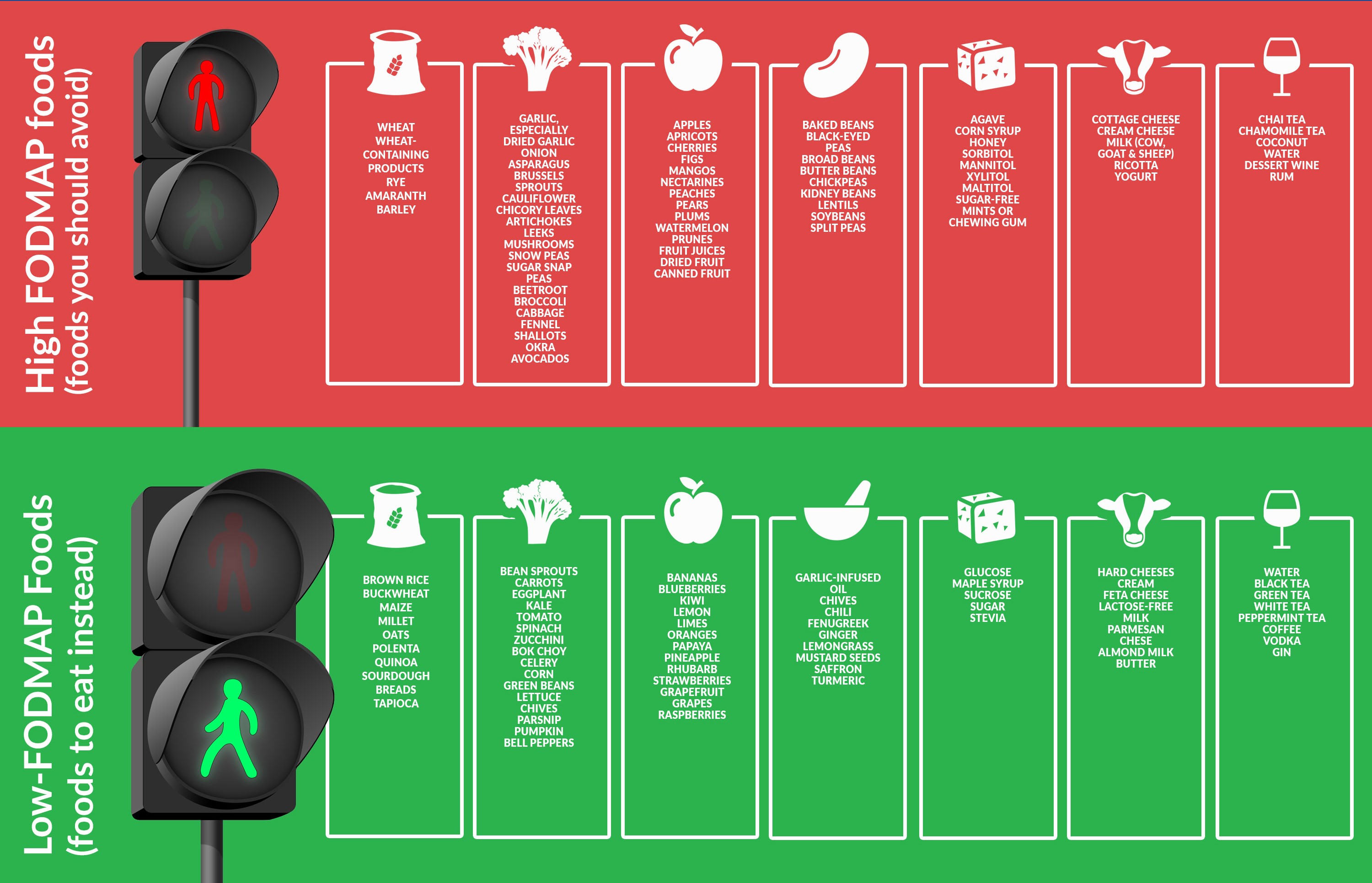
Step 1 Low FODMAP diet
In Step 1, follow the Low FODMAP Diet by swapping high FODMAP foods in your diet for low FODMAP alternatives. For example, if you normally eat wheat-based toast with honey for breakfast, you could swap to sourdough spelt toast with jam.The Food Guide of the Monash FODMAP App is very useful in this step of the diet. Use the simple traffic light system to identify high (red) and moderate (amber) FODMAP foods that you will swap for low (green) FODMAP alternatives.
Follow the Step 1 diet for 2-6 weeks. If your symptoms improved after 2-6 weeks on the Step 1 diet, it is time to move onto the Step 2 diet. If they did not improve, it might be that your IBS symptoms are not sensitive to FODMAPs and you need to consider other therapies, such as stress reduction, gut directed hypnotherapy, over-the-counter medications such as laxatives, fibre supplements, or prescription medications.
Step 2 FODMAP re-introduction
In Step 2, you continue your low FODMAP diet. However, you will complete a series of ‘FODMAP challenges’ to identify which FODMAPs you tolerate and which trigger symptoms. FODMAP ‘challenges’ involve eating a food rich in only 1 FODMAP group daily for 3 days and monitoring symptoms.The diary section of the Monash FODMAP App is very useful in this step, as it lists foods that you can use for each FODMAP challenge. These foods are recommended because they contain large amounts of one FODMAP type. For instance, milk is high in lactose, but does not contain any other FODMAPs.
Very common foods (such as apple, pear, certain legumes and wheat products) that are high in two FODMAP types are also included as optional challenges in the diary. After each 3-day challenge, record how well you tolerated the FODMAP(s). You can do this using a paper diary, or the Diary in the Monash FODMAP App. The in-app Diary allows you to record challenge foods eaten, IBS symptom type and severity, bowel habit and stress levels.
Step 3 FODMAP personalization
In Step 3, the aim is to relax dietary restrictions as much as possible, expand the variety of foods included in your diet and establish a ‘personalized FODMAP diet’ for the long-term.In this step well tolerated foods and FODMAPs are reintroduced to your diet, while poorly tolerated foods and FODMAPs are restricted, but only to a level that provides symptom relief. We recommend that you repeat challenges of poorly tolerated foods and FODMAPs over time to see whether your tolerance changes. You can also use the Filter function in the Monash FODMAP App to personalize your app experience during Step 3 of the diet.
Conclusion
As we navigate the complex terrain of dietary strategies, the Low FODMAP diet stands out as a promising approach for those seeking relief from digestive discomfort, particularly individuals with IBS. While the merits are evident, it's important to note that the diet is not one-size-fits-all, and personalized guidance from healthcare professionals and registered dietitians is paramount to ensure nutritional adequacy and long-term success.Recent posts
- Daylight Saving Time: tips and tricks for a smooth adaptation
- Being a grandparent doesn't just bring joy but also rejuvenates your brain
- Wide awake at night but tired in the morning? How to cure insomnia!
- Fall prevention tips for elderly people
- How Heart Rate Variability can be an indicator of your well-being
- Biting insects, what causes them to be attracted to you and what can you do to repel them?
- How can athletes beat the heat with heat adaptation training?
- Health benefits of infrared light therapy
- How do you prevent a sunstroke or heatstroke?
- How to become super strong and muscular in a responsible way!
Author
Yvana van den Hork
Rank: Senior Editor
Position: Director
She holds an MSc in Toxicology and Biology of the Wageningen University
All author posts
Contents
Language for this blog
Pasio ingredients

- Vestiging: Wageningen | Julianastraat 99 | 6707 DC | NL
- Telefoon: +31 (0)6 5107 9358
- Mail contact: orders@pasioonline.com
- Bestellingen worden gereed gemaakt voor verzending maandag t/m vrijdag tussen 9.00 en 16.00. Zaterdag tussen 10.00 en 14.00 uur. Bij verzending maken wij gebruik van PostNL en DPD. Afhalen alleen na afspraak en vooruitbetaald. Probiotica worden niet retour genomen.
My account
Customer Service
Klantenservice
© 1998 - 2026 Mungotedo LLP.