



Can training with just weight machines make you stronger?
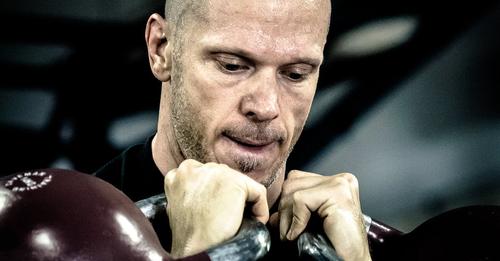
Can training with just weight machines make you stronger?
Whomever has been a member of a gym in the past 15 years, will have noticed how slowly but surely, machines have taken a back seat and more and more space is given to 3-dimensional weight equipment, like suspension (TRX-)trainers, gym balls, kettle bells and even fun stuff that were formerly totally unheard of like pole dances and climbing walls.
A very popular trend is the development of Cross-Fit in which both strength and endurance is equally valued and in which Olympic weightlifting exercises are also incorporated.
As someone who has dabbled both in Olympic and power lifting as well as endurance cycling, I've been very happy about this development even though I keep using machines myself too. Recently, Christian Finn, a coach who specialized in rehab training, pointed out how machines have a more important role than most of us realize. It's well worth sharing it in our blog, too.
Machines can increase your functional strength... really!
Trainers who avoid using machines, and gym owners who scrap them altogether, are doing a disservice to their clients.I saw something very strange when I walked into a gym recently.
Actually, it was what I didn’t see that I found strange.
I saw barbells, squat racks, dumbbells, kettlebells, medicine balls, a sled, and some suspension trainers. Machines like the leg press, leg extension, and leg curl were conspicuously absent.
I asked one of the instructors if there was a separate room for the machines.
“We don’t have any machines in here,” he said. “They’re largely worthless because they don’t build functional strength. Sitting on a machine doesn’t transfer to real-life activity. You can do everything you need with free weights. Nothing beats compound exercises like squats and deadlifts.”
It’s not the first time I’ve heard statements like these. The idea that strength is only functional if you build it with certain exercises and certain types of equipment has become the conventional wisdom for many trainers and strength coaches.
But is it actually true? Let’s see what the research can tell us about the effects of training with machines in three key areas:
- functional carryover
- muscular development
- recovering from an injury
Functional Carryover
We’ll start with the idea that the strength you build with machines like the leg press, leg extension, or leg curl doesn’t transfer to anything you do outside the gym. That is, you don’t run faster, jump higher, or improve your endurance.
The argument goes something like this:
“There’s no sport or activity that involves sitting down and pushing a weight away from you, or sitting down and straightening your legs with a weight pushing down on your shins.”
This should be easy to test, and indeed many studies over the years have used machine-based training routines to enhance athletic performance.
For example, in this 2011 study of elite cyclists, Danish researchers found that a combination of strength training and cycling improved performance during a 45-minute time trial to a greater extent than cycling alone. This was purely a machine-based routine: leg extension, leg press, leg curl, and calf raise.
Without any help from the squat, lunge, or deadlift, the cyclists somehow improved their endurance by an impressive 8 percent in 16 weeks.
In a 2017 study, Spanish researchers trained a group of pro handball players with two different types of leg press: the conventional 45-degree leg press and one that uses a flywheel. Both produced improvements in a variety of performance measures, including 20-meter sprint time and vertical jump height.
Were these training programs ideal for the elite competitive athletes who used them in the studies? Certainly not. I don’t think anyone reading this would write machine-only programs, if all options were on the table.
The key point, though, is one all fitness pros should understand: An exercise doesn’t have to be identical to an activity for the strength it builds to improve performance.
Muscular Development
Basic physiology tells us that bigger muscles are typically stronger muscles. While the ratio isn’t exactly one to one, we know that if your client increases the size of his thigh muscles, he’ll almost certainly have stronger legs as a result.
The squat is often described as the best overall exercise for lower-body muscle mass. But let’s consider the comparative benefits of the leg press.
Obviously, there’s less reliance on technique with the leg press, which makes it an easier alternative for clients who are new to strength training.
But for many clients, lower back strength will be the biggest limiting factor during the squat. Their form will break down before the legs have gotten a sufficient training stimulus. That’s rarely a factor with the leg press; you can use higher volume and heavier loads with less risk of injury.
“Less risk” doesn’t mean “no risk.” As Stuart McGill, PhD, notes in Low Back Disorders, allowing a client’s pelvis to come off the back support causes the lumbar spine to flex under load, potentially putting her at risk for a disc herniation.
To mitigate the risk, McGill recommends pressing with one leg at a time to ensure the pelvis stays in contact with the pad—which brings me to another potential advantage to using the machine: Your client can isolate each leg without balance being a limiting factor, as it might be with free-weight exercises like the split squat, lunge, or step-up.
Another important point: The quadriceps, as you know, is a group of four muscles. No exercise works all of them to the same degree.
That’s where the much-maligned leg extension comes in handy. It’s most effective for stimulating the rectus femoris, the dual-function muscle that acts as both a knee extensor and hip flexor.
While the squat produces high levels of muscle activation in the vastus lateralis and vastus medialis, the leg extension typically produces higher levels of rectus femoris activity.
In a 12-week program using the leg extension exclusively, the rectus femoris grew much faster than the other three muscles in the quads.
For the hamstrings, a combination of free-weight and machine exercises delivers better results than either one alone.
A 2015 study in the Journal of Strength and Conditioning Research showed that the lying leg curl and stiff-legged deadlift produced similar activation of the upper hamstrings. However, the leg curl led to greater activation of the lower lateral and medial parts or the muscle.
Here’s how study author Brad Schoenfeld describes the results:
“The differences in activation of the lower hamstrings was stark, with the leg curl showing greater lower lateral hamstrings activity of approximately 170 percent and lower medial hamstrings activity of approximately 65 percent compared to the stiff-legged deadlift.”
Of course, none of your clients come to you with the goal of increasing the girth of their lower hamstrings. And even if someone wanted to, you’re still limited by both genetics and the difficulty of isolating specific areas of individual muscles, relative to other parts.
So your best bet for overall development is to use a variety of exercises to ensure you work all sections of the targeted muscles. Since machines are better at training some of those areas, you’d want to include them in the program.
Injury Recovery
Machine-based exercises are useful when you need to work around problem areas. So when a client with a back injury can’t do squats or deadlifts safely, you can still work the muscles using a mix of leg presses, extensions, and curls.Even better, machines can help treat certain injuries. Take patellar tendinopathy, for example. Also known as jumper’s knee, it’s an overuse injury of the connective tissue attaching the kneecap to the front of the tibia. (Although it’s usually called the patellar tendon, it’s actually a ligament.)
In an intriguing study from the same Danish group I cited earlier, men with patellar tendinopathy who did heavy, slow resistance training three times a week got superior results compared to matched groups who either got corticosteroid injections or did eccentric single-leg squats twice a day—an often-recommended treatment for jumper’s knee.
The lifters did three exercises each session—squat, leg press, hack squat—for four sets of six to 15 slow reps (three seconds up, three seconds down).
After 12 weeks, the improvements in knee pain and function were similar for all three groups. But it was a different story after six months. The two exercise groups maintained their improvements, while those who got the injections regressed. Interestingly, the lifters had an increased rate of collagen turnover, a sign their injured ligaments were making positive adaptations.
Put another way, those who did a mix of machine and free-weight exercises not only had less knee pain, they also had a more robust healing process, compared to the other groups.
A more recent study looked at whether in-season competitive volleyball and basketball players with jumper’s knee could decrease pain in their knees without cutting back on their training load or playing time.
The athletes did leg extensions either with isometric (with a pause) or slow isotonic contractions in the way the exercise is mostly executed.
Both groups saw significant pain reduction, although a later study by the same group showed more immediate pain relief among those who did isometric leg extensions.
Final thoughts
Let’s review what we just learned about the outcomes associated with machine exercises:
- increased speed and vertical jump height
- increased muscle mass in specific parts of muscles that are hard to develop with free-weight exercises
- accelerated recovery and reduced pain in knee joints
All of those are clearly “functional” outcomes. That is, they produce positive changes in areas your clients want to improve. And that’s without mentioning increased strength, which makes life in general easier to navigate.
So why are machine exercises so often described as nonfunctional?
The problem is that fitness pros who make that argument confuse inputs with outputs. Exercise selection is an input. The results of the exercise are the output. If an exercise increases strength, athletic ability, and muscle size, or decreases pain, what about that exercise isn’t functional?The results a client wants won’t come from the exclusion or inclusion of any specific exercise, but from a well-conceived strength and conditioning program that incorporates a variety of exercises.
Even if most of them are done with free weights, there’s no good reason why machines like the leg press, extension, and curl can’t be part of the program.
source: Weight Machines Build Functional Strength. Seriously.
Recent posts
- Daylight Saving Time: tips and tricks for a smooth adaptation
- Being a grandparent doesn't just bring joy but also rejuvenates your brain
- Wide awake at night but tired in the morning? How to cure insomnia!
- Fall prevention tips for elderly people
- How Heart Rate Variability can be an indicator of your well-being
- Biting insects, what causes them to be attracted to you and what can you do to repel them?
- How can athletes beat the heat with heat adaptation training?
- Health benefits of infrared light therapy
- How do you prevent a sunstroke or heatstroke?
- How to become super strong and muscular in a responsible way!
Author
Contents
Language for this blog

- Vestiging: Wageningen | Julianastraat 99 | 6707 DC | NL
- Telefoon: +31 (0)6 5107 9358
- Mail contact: orders@pasioonline.com
- Bestellingen worden gereed gemaakt voor verzending maandag t/m vrijdag tussen 9.00 en 16.00. Zaterdag tussen 10.00 en 14.00 uur. Bij verzending maken wij gebruik van PostNL en DPD. Afhalen alleen na afspraak en vooruitbetaald. Probiotica worden niet retour genomen.