


Biting insects, what causes them to be attracted to you and what can you do to repel them?
Biting insects, what causes them to be attracted to you and what can you do to repel them?
I don't know if you've noticed, but this year there's not so much a mosquito plague as a horsefly plague. At least, that's the case where a good friend of ours lives, where my partner regularly helps out as a caregiver.
She lives in a marshy peatland, and especially this past July, my sweetheart was not only attacked by mosquitoes, but at least as much by horseflies. And boy, they can bite much more viciously than mosquitoes. While mosquitoes only give a mild sting that itches quite a bit afterwards, getting stung by a horsefly is a completely different matter.
How come there are suddenly so many horseflies? Well, horseflies thrive under the same conditions as mosquitoes and house flies: warm and especially humid weather are optimal living conditions.
How to keep (horse) flies away
Horse flies are notorious for their painful bites, thanks to scissor-like jaws. Female horse flies, like female mosquitoes, want to nourish themselves with your blood. (Male horse flies primarily stick to nectar.) But unlike a mosquito bite, which may not be noticed until it begins to itch, a horse fly bite will result in a big "ouch!" If your yard is plagued by these big flies, follow these tips to get rid of horse flies, and help protect you, your household and your pets (or livestock).
What is a horse fly?
Horse flies are insects. These flies are about the size of the house fly you see buzzing about, snacking on any food left available. They can also grow as big as a bumble bee, which can make anyone unfamiliar with horse flies uneasy around them. In fact, some people call horse flies “green-headed monsters.”
These flies are considered pests — they need hosts, which can include mammals like horses and cows. However, they may also choose to feed no humans or pets. If a horse fly manages to bite, you can expect several symptoms, including swelling and itchiness and for people who are allergic to anticoagulant compounds, symptoms can become more severe, including wheezing, dizziness, and weakness.
If a horse fly manages to bite, you can expect several symptoms, including swelling and itchiness.
You can find horse flies in a variety of different environments, including wooded areas and along streams. These flies zip about quickly and may carry several different animal diseases like tularemia and anthrax. Although the females feed on blood, the males opt for a different set of menu items, including plant sap and nectar. They’re not too keen on finding hosts and ensuring survival off blood-sucking.
What is a house fly?
You are likely more familiar with house flies than with horse flies. These are the flies you are constantly swatting away from your plate of food when enjoying a barbecue outdoors with your family. These are a nuisance and beyond that, they also carry diseases. If enough are concentrated in a single area, it could cause a public health issue.
House flies grow to about seven millimeters long and typically, the females are larger than their male counterparts. It’s easy to confuse the house fly with the stable fly but when you compare the appearance of a horse fly and a house fly, the differences are visually evident. If a house fly doesn’t have a consistent source of food, it dies off within two or three days.
The most common types of flies you are likely to find in your home are house flies.
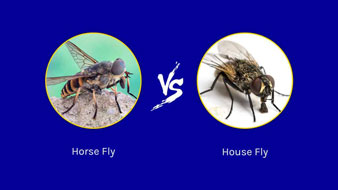
Horse fly vs. house fly: 5 key differences
| characteristic | horse fly | house fly |
| size | 1,9-3,2cm long | 0,6-0,7cm long |
| diet | males: nectar and pollen females: blood from mammals |
food, animals, and fecal matter |
| behaviour | agressive biters | diurnal and rest at night |
| appearance | solid wings and brightly coloured eyes | dull gray with four dark stripes |
| life span | 30 to 60 days | 28 days |
Fatal attraction to biting insects
If you've ever felt like insects target you more than others, you're not imagining it. Your body's scent, chemistry and even recent meals influence how attractive you are to insects . That's one reason some people look for ways to change how they "smell" to bugs from the inside out.
One natural solution that keeps coming up, especially in wellness circles, is vitamin B1. Also known as thiamine, this nutrient helps your body turn carbs into fuel. It's found in whole foods like grass fed liver, beans and whole grains. But beyond its metabolic role, some people believe that taking extra B1 alters your body odor enough to deter insects.
It's a popular idea but not a new one. Thiamine was first floated as an insect repellent more than 70 years ago. Since then, it's become a recurring tip in natural health advice columns and supplement forums. Still, its effectiveness is debated, and scientific evidence hasn't always supported the claims. So, does thiamine actually make you mosquito-proof? Or are people chasing a myth?
People swear by Vitamin B1 for mosquito protection, but science tells a different story
There's a widespread belief that vitamin B1 helps repel mosquitoes by altering body odour. Many people claim that taking a daily supplement or wearing a B1 patch makes them "invisible" to mosquitoes. But do these claims hold up under scientific scrutiny?
• Despite popular belief, research doesn't support B1 as a repellent. Multiple studies, including a 2022 systematic review and a University of Wisconsin trial — found no difference in mosquito activity between people who took B1 and those who didn't. Even though thiamine plays an important role in your energy metabolism and is safe at recommended doses, relying on it for bug protection is not supported by high-quality human studies.
• The science is thin but intriguing — The 2022 scoping review published in the Bulletin of Entomological Research pulled together available research on thiamine as a mosquito repellent. Researchers from Cambridge University examined 16 studies published over more than 80 years, including human clinical trials, animal studies and insect behavior experiments.
Some older studies showed mild to moderate repellent effects, but not consistently. The review highlighted that a handful of early studies found a reduction in mosquito landings when participants took B1 supplements. However, results varied, and later studies either didn't replicate the effect or used different methodologies that made comparisons difficult.
• Many users still say it works for them — Personal stories still fuel belief in B1's mosquito-repelling powers. Some people report getting fewer bites after using it, which could be due to individual differences in body chemistry or simply the placebo effect.
• B1 is harmless at safe doses, so trying it isn't risky — Thiamine is water-soluble, meaning your body flushes out what it doesn't use through urine and sweat. Because of this, it's generally considered safe, even at higher-than-dietary doses. Plus, most people don't get enough B vitamins anyway. That said, it's not a free pass. You shouldn't use it as your only form of mosquito protection, especially if you're in a high-risk area for insect-borne illness.
• Supplemental B1 is the most practical way to reach mosquito-repelling levels — Because vitamin B1 is water-soluble and not stored in your body, you have to consume it daily. To reach levels that affect your body odor enough to repel mosquitoes, you'd typically need more than food alone provides. That's why a daily supplement of 50 to 100 milligrams (mg) is generally recommended for this purpose.
How to stop insects from biting you?
If you're looking for a safer way to repel mosquitoes without slathering your skin in synthetic chemicals, you're not alone. The good news is, there are multiple ways to defend yourself. Some start in your kitchen cabinet, others in your backyard. Here are a few recommendations:
1. Try vitamin B1 if you're prone to frequent bites — Some people notice they get bitten less when they take 50 to 100 mg of thiamine daily. It's thought that higher levels of B1 alter your body odour in a way mosquitoes dislike.
While recent scientific reviews haven't found consistent evidence to prove this works for everyone, B1 is water-soluble and low-risk in modest doses, especially if your intake is low to begin with. If you're curious to try a natural internal approach, this is a safe first step.
2. Use plant oils that rival DEET in strength — Russian sage, wild mint and tangerine peel oils gave strong protection in lab tests — up to 2.25 hours depending on the dose. At higher concentrations, Russian sage matched the performance of DEET.
These oils didn't irritate the skin and had no unpleasant odor, making them a safer topical choice for kids and adults alike. Look for them in essential oil form. Mix with a carrier oil like coconut oil and apply regularly when outside.
3. Tap into traditional herbal blends for long-lasting results — Two traditional plants — Hatkora (a wild citrus fruit) and Anchiri (a fragrant root used in Ayurvedic traditions) — offered more than six hours of protection when their oils were combined. Anchiri oil alone worked for 6.16 hours. These oils contain linalool and limonene, which confuse mosquito scent receptors while also offering anti-inflammatory and antioxidant benefits.
4. Eliminate breeding grounds around your home — Mosquitoes nor flies don't travel far from where they hatch. That means standing water on your property, like birdbaths, clogged gutters and buckets, becomes an open invitation. Dump or refresh these weekly. Cut back dense shrubs and mow your lawn to remove shady hiding spots. Add mosquito-repelling herbs like citronella, lavender and marigold near entryways and seating areas.
5. Support nature's best mosquito hunters — Bats are your backyard allies with voracious appetites for mosquitoes. Installing a bat house is a low-effort, high-reward way to cut down on bites while helping local wildlife. It's a natural control method that keeps working long after you've gone inside.
How to get rid of (horse) flies? Clean up!
Maintain your yard. Horse flies love damp areas and hot weather, and it's common to find them in pasturelands near creeks during the summer. Around homes, they enjoy weedy areas and long grass that can trap moisture and recreate the humid pasture habitat they love so much. Horse flies can also be pests to people who hang out at the beach or local pool.
Remove garbage. Seeking food, horse flies (like other fly species) will hone in on garbage. Outdoor trash bin lids should fit snugly. If you can store your trash in your garage, you may see fewer flies around your yard.
Clean up after pets. Horse flies, like many other insects, are attracted to animal feces. If you have a dog, you will have to clean up your yard more frequently in the summer, or you may have a horse fly problem on your hands.
Different ways to actively get rid of flies outside
Many methods exist to help you get rid of flies outside instantly. Other ways to cut down on these pests may take some time. Your best bet is to use a combination of approaches along with preventative measures to reduce the number of flies around your patio. Use these techniques to quickly rid your area of flies.
Put up sticky fly traps
Sticky fly traps are unpleasant because they have a powerful scent. Yet, few things attract the flies in your yard to one area faster than these. Once they flock to these sticky traps, the flies will get stuck to them, resulting in their demise. While unpleasant, these traps can clear a patio area very quickly.
Implement light-based fly traps
Flies are naturally attracted to bright lights. So, if you are sitting on your patio at night, using a light-based fly trap can be a great way to clear the yard. Of course, these light traps do not instantly kill a dozen flies. However, they will leave you and your guests alone to focus on the light and slowly dwindle in numbers. Once they strike the trap, they’re zapped by electricity and die.
You can leave the light on after you go inside to let the trap do its work all night, so you wake up to fewer flies in the morning.
Use strong-smelling cleaners to ward off flies
Flies dislike the scent of pine oil. Naturally, it is smart to use their dislikes against them to make them leave your backyard. While it is not a good idea to spray undiluted pine oil around your backyard, you can use a diluted mixture in some areas.
Try mixing a cleaner with pine oil or pine oil itself in a 50/50 mixture with water. Use that to wipe down tables and chairs or to spray in places where flies congregate. They should disperse soon after.
Use citronella candles
Burning a citronella candle is a good way to get flies to leave an area. These are simple tools that work with various levels of efficacy. However, if you want to get rid of flies outside instantly, light a few of these types of candles or torches. The biggest problem is that the flies will return to whatever food or scent attracted them to your yard after the scent dissipates. Citronella candles are best used in conjunction with other tools to remove flies from your patio.
Getting rid of flies outside can be a challenge. However, several preventative and proactive measures can be used together to reduce their populations outside your home. Of course, getting rid of flies inside your home is another challenge altogether, but the process can use similar measures. Be ready to change some elements of your life, like where you store your garbage, to stop flies from disrupting a nice barbeque.
Vinegar trap with dish soap
While vinegar is one of those miraculous household items that can work wonders on so many different issues like stains, odors, and hard-to-clean areas, in the case of repelling flies it does not keep them away. In fact, vinegar actually attracts flies. If that is true, then how can vinegar be a useful household item to get rid of them?
The genius of using vinegar is to use it as a natural bait for flies rather than as a repellent, and then incorporating it with something that will actually take them out for good. A great material to partner with vinegar is dish soap. As the vinegar attracts the insects and causes them to land on the concoction, the dish soap will effectively draw the bugs downward to the bottom and drown them.
Recent posts
- Daylight Saving Time: tips and tricks for a smooth adaptation
- Being a grandparent doesn't just bring joy but also rejuvenates your brain
- Wide awake at night but tired in the morning? How to cure insomnia!
- Fall prevention tips for elderly people
- How Heart Rate Variability can be an indicator of your well-being
- Biting insects, what causes them to be attracted to you and what can you do to repel them?
- How can athletes beat the heat with heat adaptation training?
- Health benefits of infrared light therapy
- How do you prevent a sunstroke or heatstroke?
- How to become super strong and muscular in a responsible way!
Author
Contents
Language for this blog

- Vestiging: Wageningen | Julianastraat 99 | 6707 DC | NL
- Telefoon: +31 (0)6 5107 9358
- Mail contact: orders@pasioonline.com
- Bestellingen worden gereed gemaakt voor verzending maandag t/m vrijdag tussen 9.00 en 16.00. Zaterdag tussen 10.00 en 14.00 uur. Bij verzending maken wij gebruik van PostNL en DPD. Afhalen alleen na afspraak en vooruitbetaald. Probiotica worden niet retour genomen.