How to align training with each phase of your menstrual cycle
It's been quite a while ago when menopause started , but in the last few years before my body finally stopped ovulating, I was quite fanatical in the gym. After I stopped practicing extreme endurance sports, the cycle normalized due to a calmer lifestyle, so I almost automatically started to adjust my strength training schedules to my cycle. This was prompted by two important phenomena.
Firstly, it was quite obvious to take a break from strength training on the first two days of the cycle because I experienced too many cramps to feel good enough to train. In addition, I suffered quite a bit from binge eating before my period, while appetite would be virtually absent in the first few days of a cycle.
Since I have been struggling with some excess weight for almost my entire adult life, it was a logical step to use that lack of appetite by trying to lose some weight and on the other hand, to schedule the toughest training sessions on days when I spontaneously ate too much anyway. After all, it is almost a law of nature that those who eat little, perform poorly and those who eat (more than) enough and experience no pain, perform optimally.
Ever since menstruation cycles are absent, this natural fluctuation in appetite no longer occurs, but because I see quite a few fanatical sportswomen in the gym and among our customers, I thought it would be interesting to find out what the state of science is.
So I listened with great interest to the podcast 'Slimmer Presteren' (Perform Smarter) which was specifically dedicated to 'smarter performance with knowledge of the menstrual cycle'.
The researcher who was interviewed studied a relatively small group of sports women with a cycle of 21-45 days, which meant that no really statistically significant results emerged.
However, women did report an effect on an individual basis, such as depressive feelings just before menstruation. Depressive feelings can negatively affect your confidence levels, which is of course more important in dangerous sports such as ski jumping.
Women also complained about poorer sleep due to higher body temperatures at the end of the cycle, which can of course also have a negative effect on sports performance.
In general while it was true that few hard conclusions could be drawn on the basis of mostly too small, statistically less relevant studies, but the average sportswoman is well advised to keep a close eye on her own individual cycle for a possible connection with sports performance.
Even more important was the observation, which I can also confirm from my own experience, that extreme stress can really mess up your cycle. For example, menstruation invariably did not occur during a somewhat longer trip abroad, partly because that was usually a very active walking or cycling holiday where I spent considerably more energy every day than I consumed both for lack of time as well as for economic reasons. Finally, the researcher recommended using a contraceptive pill when women suffered from a lot of pain, despite the fact that it may have a small negative effect on sports performance.
Finally, she brought up an anecdote from research with female swimmers that showed that women with the most disrupted cycles performed the worst, which almost universally turned out to be related to a too low calorie intake. In short, we are back to my own approach of having the toughest training sessions coincide with the natural tendency to eat the most in the last week before menstruation.
Thus my own observations versus the observations of this researcher.
About time to see what advise has been given to women who want to follow the 'general consensus' on hormonal influences on your training cycle.
How to exercise in each phase of your menstrual cycle
Ready to optimize your training by cycle syncing your workouts? Here’s a week-by-week guide for exactly how to exercise in each phase of your menstrual cycle.
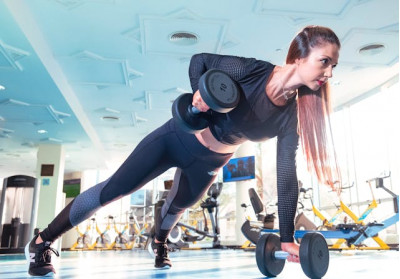
Woman cycle syncing her workouts by doing high intensity training in the first half of her cycle.
If you exercise regularly, you’ve likely had your period show up right before an important or more intense workout. When it happens, it’s more than just annoying. It can also negatively impact your motivation, energy, and performance.
Despite it seeming like a game of chance, there is a way to start syncing your workouts in order to take advantage of the hormonal shifts in your body. It’s called cycle syncing, which can be extremely helpful for your training results.
When it comes down to it, the menstrual cycle is simply a series of hormonal shifts, and those shifts can be used to your advantage when it comes to the working out in each phase. In fact, syncing other aspects of your life, like cycle syncing your food and cycle syncing your skin care can also have a positive impact on your health. Long term, it’s an incredible way to balance hormones naturally.
When implemented properly, cycle syncing workouts to your menstrual cycle can make it easier to stick with a fitness plan, decrease recovery time, and as a result—improve how you look, feel, and perform. It also means not fighting your body or working against it, which as a general principle is a way more enjoyable way to live.
Phases of the menstrual cycle
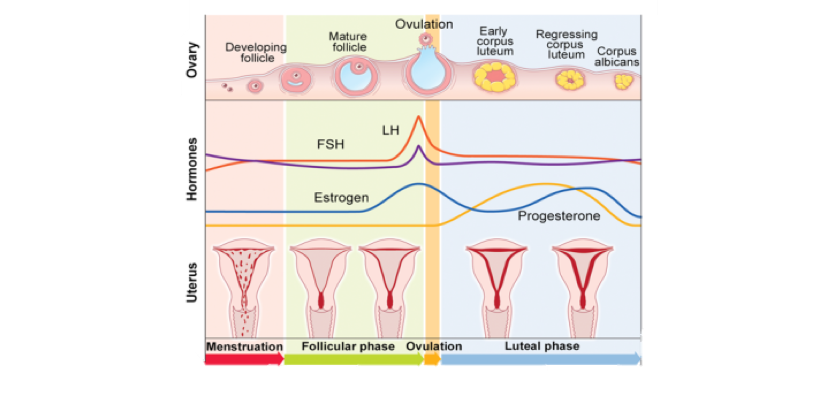
In general, the menstrual cycle occurs in two phases. The first phase, which starts the first day you get your period and lasts until the day you ovulate, is called the follicular phase. During this phase, estrogen increases in order to stimulate follicle growth.
The second phase is called the luteal phase. This phase starts the day after you ovulate, and goes until the day you start your period. During this phase, progesterone increases (as does your body temperature), estrogen increases slightly, and both taper off in the event the egg isn’t fertilized to start the cycle over again.
Breaking it down even further which becomes important when talking about how to train with your menstrual cycle, the first 5 days of the follicular phase are known as the menstrual phase when the uterus sheds its inner lining. In between the follicular phase and the luteal phase is the ovulation phase, which is the day the ovary releases a mature egg cell.
Length of your menstrual cycle
Most conventional establishments break down the phases of the menstrual cycle according to the days they occur. Unfortunately, this can be inaccurate for some as a normal menstrual cycle can last anywhere from 23-36 days. While the average cycle length is 28 days, most women will vary from this. But, you do need to know what phase you’re in in order to start cycle syncing your exercise.
In order to figure out the length of your cycle and when each phase occurs, there are a few simple things you can track on your own. As outlined in the method '
Taking Charge Of Your Fertility', once ovulation occurs, you experience a significant rise in your Basal Body Temperature (BBT). This rise is typically 0.25 degrees Celsius, and the temperature shift is sustained until progesterone begins to drop off and menstruation starts over again. The day just before this temperature shift is the day you ovulated.
Tracking your temperature shifts, along with a secondary metric such as cervical fluid, will give you a clear picture of your cycle length and what day ovulation typically occurs.
This information is not only valuable when it comes to cycle syncing your workouts, it’s also incredibly important when trying to conceive, or prevent a pregnancy.
To track your cycles, you simply take your BBT each morning at the same time before getting out of bed with a basal thermometer. You can track your temperature changes on a printable chart, which also includes space to note changes in cervical fluid.
Hormones, glucose, and energy levels
While there is limited research about cycle syncing, studies shows there are factors that may affect your workouts.
First, the rise in core body temperature that occurs after ovulation can affect how quickly you fatigue. One study showed that during the luteal phase, time to fatigue was reduced in hot and humid conditions. Additionally, studies suggest that insulin sensitivity changes throughout your cycle.
Insulin is a hormone produced by the pancreas that escorts glucose out of the blood stream and into muscle, liver, and fat cells. Estrogen and progesterone mildly influence insulin and cortisol, which can change the way your body utilizes and stores fuel. For example, insulin sensitivity is higher during the follicular phase due to higher levels of estrogen. Additionally, studies suggest carbohydrates are used more efficiently in the follicular phase.
Testosterone levels also tend to be higher during the follicular than the luteal phase, though the variation isn’t nearly as large as for estradiol and progesterone.
While these changes are important to note when it comes to optimizing your training, in the majority of cases, these differences do not alter overall performance capacity. In other words, you can work with your changing patterns of insulin sensitivity, but your immediate performance capacity is not affected by these physiological changes.
The bottom line: Your body is more insulin sensitive at the beginning of your cycle when estrogen is higher, and becomes more insulin resistant during the second half of your cycle when progesterone is higher.
How to start cycle syncing workouts
So, what does this mean when it comes to cycle syncing your workouts? When the body is more insulin sensitive, during the first half of your menstrual cycle, you need less insulin to keep blood glucose levels in the normal range. In other words, it’s easier to keep your body’s cells supplied with glucose and carbohydrates are used more efficiently.
During the follicular phase, doing higher intensity training like interval or sprint workouts is ideal. This also lines up perfectly with a peak in your energy levels.
Studies show that your basal metabolic rate decreases during the follicular phase, hitting its lowest point one week before ovulation. Doing higher intensity training during this time will counteract this change, and give an added boost to your metabolism.
On the contrary, when the body is less sensitive to insulin (or, more insulin resistant) during the second half of your cycle, it has a hard time properly storing glucose. In other words, glucose uptake in muscle and fats cells is impaired. During the luteal phase, aerobic efforts—ones that do not require fast access to glucose—are more advantageous. This coincides with a drop in all hormones and your energy during you cycle.
These factors, combined with the general shifts in energy and fatigue that can occur throughout the menstrual cycle make structuring your workouts according to your cycle a potential rock-solid strategy for optimizing your workouts long-term.
The hormonal shifts of the menstrual cycle can be used to your advantage when planning your workouts.
Cycle syncing workouts: week by week
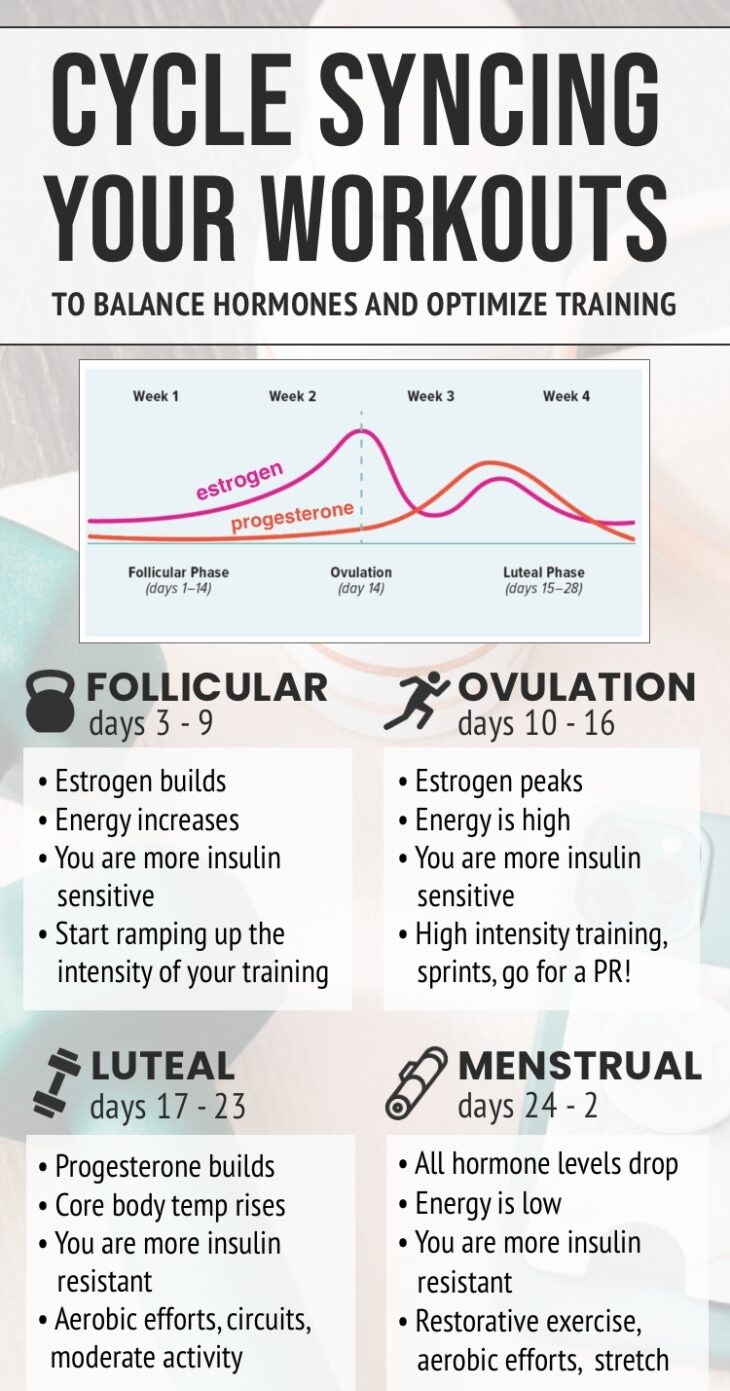
As a general guideline, cycle syncing your workouts is broken down into a 4-week period. While the days are set to a 28-day cycle, this can absolutely be customized to your cycle and needs. The type of exercise you choose to do in each phase of your cycle isn’t what matters. What matters is the intensity.
Note: The “ramp up” begins right when menstruation tapers off. Shift this according to your mensuration length. Also, not everyone ovulates on day 14, so the highest intensity week occurs around ovulation (between days 10 and 16). If you need to shift this slightly to better fit your needs—please do!
Week 1 (days 3 – 9): increased load or intensity
Week 1 occurs in the first half of your follicular phase. During this time, you can increase the intensity of your exercise and start lifting heavy. Think of it as a week to “prime” yourself for maximum load and intensity. This is a great time to do interval workouts. Be sure to include a sufficient warm-up, as you’re coming off a down week.
Week 2 (days 10 – 16): high load or intensity
This week is the second half of the follicular phase and rolls right into ovulation. During this time, you may find that your energy is at its peak. To take advantage of this, you can incorporate a few workouts that use max efforts. Now’s the time to attempt a PR, lift heavy, or try something new. Doing shorter, hard sprints is great during this time if it is within your ability.
Week 3 (days 17 – 23): aerobic efforts
Right after ovulation comes the first week of the luteal phase. During this time, you may find you do better with aerobic exercise. Moderate loads and longer, less intense workouts are ideal. Bike rides, trail runs, or circuit-style training are all great options. As you start to move towards the end of this week, taper your training off according to how your body is feeling as you experience PMS symptoms. Be sure to remain hydrated and be mindful of the fact that your core temperature has increased.
Week 4 (days 24 – 2): The down week
This phase starts when your PMS symptoms start to become more prominent. During this time, you can do light activities like swimming, easy biking, yoga, or just chilling hard. When your period starts, continue to do more restorative exercise. Once it tapers off, start back with the ramp up.
Customizing your workout plan
To reiterate, these weeks are a general guideline that is simply meant to break down the menstrual cycle into four phases when cycle syncing your workouts. If your cycle is more or less than 28 days, your specific days will likely vary. For example, if you have a 30-day cycle, you may choose to add an extra day or two to your aerobic period according to your symptoms.
As an example, someone who tends to have intense abdominal cramping 48-72 hours before the first day of the menstrual cycle, which is aggravated greatly by higher intensity training, the “down” week can begin on the last few days of a cycle, and the “ramp up” can start on day 3 or 4.
This concept can be adapted to your individual goals and the specific type of exercise you’re doing. Long term, you absolutely want to be periodizing your training so that you aren’t doing the same thing week after week, month after month. As you shift into different training phases, you can implement the general strategies of training with your menstrual cycle.
When in doubt, don’t stress
Rest assured, if your period falls on the day of a important workout or on race day, you aren’t doomed to failure. The most important thing you can do is show up well rested, fueled, and with a positive mindset. Furthermore, if you’ve done the proper training and prepared your body for success, your body will perform appropriately, even on day 1 of your cycle.
Finally, because the effects of chronic stress can greatly interfere with sex hormone production, the best recommendation for cycle syncing exercise is to be mindful of managing stress. Chronic stress can result in chronic cortisol output, which can disrupt your menstrual cycle and lead to symptoms of overtraining, including fatigue, decreased performance, and loss of motivation.