



Better fit and fat than lazy and thin? Fit at every size, yet 'fat but healthy’ is a myth!

Better fit and fat than lazy and thin? Fit at every size, yet 'fat but healthy’ is a myth!
You probably know the pattern: every year starts with good intentions to finally do something about bad habits. Countless people join the gym in January in order to get slimmer, more muscular, and/or increase fitness.
Most years, the gym won't be as busy anymore in February because people want to see results too quickly and then drop out disappointed when they don't immediately succeed.
To them, I'd like to say, hang in there! Getting fit should be your first goal if you're not already, even if you're only aiming to lose weight. Losing weight is easier these days thanks to the enormously popular Ozempic and related semaglutide-containing medications.
Just like almost anything, getting fit requires perseverance. And the great part is that once you do see progress, you'll automatically start enjoying going to the gym.
At least, that's how it worked for me when I wanted to improve my cycling performance. And as is the case for many athletes, your performance also depends heavily on your weight.
So, whichever way you look at it, the bottom line is that losing weight when overweight is important. For elite athletes, even a healthy weight can be too high; just look at the sometimes unhealthily low weights of cyclists, which even cause women to stop menstruating.
In any case, it is indeed important to accept yourself, regardless of your weight.
That's why a movement has been launched called "Health at Every Size" (HAES). Not that its proponents are blind to the disadvantages of being overweight, but they point out that being overweight is often the result of psychological distress, and acceptance can lead to a better sense of well-being.
More on that in the article below as well as the cold facts about how being overweight impacts health.
Health at Every Size (HAES)
Health at Every Size (HAES) is a popular public health framework and movement that challenges the traditional weight-centric approach to health. It promotes the idea that people of all body sizes can pursue health and well-being through sustainable, joyful behaviors — without making weight loss the primary goal.
Core Principles of HAES
The approach (as outlined by the Association for Size Diversity and Health) generally includes:
Weight inclusivity — Accepting and respecting body diversity; rejecting weight stigma and discrimination.
Health enhancement — Focusing on health-promoting behaviors (like balanced eating, movement, sleep, and stress management) rather than weight.
Respectful care — Providing non-judgmental, evidence-based support for people of all sizes.
Eating for well-being — Honoring internal cues of hunger, fullness, and satisfaction, while enjoying a variety of foods (often tied to intuitive eating).
Life-enhancing movement — Encouraging joyful, pleasurable physical activity suited to the individual, rather than exercise as punishment or solely for calorie burning.
The core message is that health is possible across a wide range of body sizes, and that weight stigma itself causes harm (linked to poorer mental health, healthcare avoidance, and even physiological stress).
What does the evidence say?
Research on HAES (including recent systematic reviews and meta-analyses up to 2024–2025) shows mixed but promising results:HAES interventions often improve psychological outcomes (better body image, reduced disordered eating, lower susceptibility to hunger, improved quality of life).
They frequently lead to positive changes in behaviors (more physical activity, better eating patterns) and some cardiometabolic markers (like blood pressure or cholesterol) — sometimes comparable to weight-loss programs, even without sustained weight reduction.
No strong evidence of harm like uncontrolled weight gain in controlled trials.
Limitations: many studies are small, short-term, or conducted by proponents; long-term sustainability and effects in people with severe obesity need more research. Some meta-analyses find no significant differences in key physical outcomes compared to controls or traditional approaches.
Critics argue that obesity carries well-established risks (e.g., higher chances of type 2 diabetes, heart disease, certain cancers), and that downplaying weight entirely might delay beneficial interventions for some.
Others point to methodological issues in HAES studies or suggest the approach can feel overly ideological.
The conversation remains active and polarized — with growing recognition of weight stigma's harms and calls for more inclusive care, alongside ongoing debates about obesity's role in health. Many experts now advocate a middle ground: focusing on behaviors and individual context rather than weight alone or dismissing it completely. Tying back to the theme "Better fit and fat than lazy and thin!", HAES strongly supports the idea of prioritizing strength, movement, and vitality over chasing a certain size — it's about being active and thriving in the body you have.
Can you be fat and still be healthy?
An estimated 15% to 20% of obese individuals have none of the metabolic derangements associated with obesity, such as high blood sugar, high blood fats, high blood pressure, Type 2 diabetes and other risk factors for cardiovascular disease.
This phenomenon has led to the idea that you can be obese yet in good health. But according to recent research, this popular belief — known as "metabolically healthy obesity" (MHO) — is a fallacy.
The myth of being ‘fat but fit’ is, again, being debunked by a new study. Researchers found that obese individuals, even if they appear healthy, have an increased risk of diabetes and ... are still 50% more susceptible to coronary heart disease.
No such thing as ‘Fat and Healthy’
High body mass index (BMI) in combination with normal glucose and lipid levels, and the absence of high blood pressure, is not sufficient for metabolically healthy obesity classification. Rather, it’s the behavior of the adipose cells that matters.
People who have normally sized adipocytes (cells that store fat), have far fewer obesity complications compared to those who have enlarged and inflamed adipocytes.
Dysfunctional adipocytes can result in fibrosis and the release of harmful molecules that contribute to organ damage. Fat-secreted hormones, known as adipokines, can also directly affect cells in your vascular system, leading to atherosclerosis.
Where you store most of your fat may also be key. Obese individuals with large visceral fat stores, meaning the fat is primarily stored around their internal organs, are far more likely to develop Type 2 diabetes than those whose fat stores are distributed more evenly around their body.
What this means in practical terms is that obese patients still need to focus on losing weight and may need other preventive treatments as well.
So there is still a residual increased risk for those people living with obesity, even with what we would call metabolically healthy obesity.
Even in the absence of other cardiometabolic risk factors, increased fat mass and adipose tissue dysfunction contribute to a higher risk of Type 2 diabetes and cardiovascular disease. Therefore, weight management and recommendations for weight loss are still important for people living with metabolically healthy obesity.
Other studies concur
Other recent research has come to the same conclusion. A prospective cohort study of nearly 400 000 British participants, found that:
Compared with people who were not obese at baseline, those with metabolically healthy obesity (MHO) had higher incident of heart failure and respiratory disease. The associations of MHO were generally weaker for fatal outcomes and only significant for all-cause mortality and heart failure mortality rates.
However, when compared with people who were metabolically healthy without obesity, participants with MHO had far higher rates of the same diseases.
Conclusions are therefore that weight management should be recommended to all people with obesity, irrespective of their metabolic status, to lower risk of diabetes, atherosclerotic cardiovascular disease, heart failure and respiratory diseases. The term ´metabolically healthy obesity' should be avoided as it is misleading and different strategies for risk stratification should be explored.
Excess calorie intake is not the cause of weight gain
Eating too much and exercising too little is not always the reason for weight gain.
Obesity is a state of energy deficiency due to inhibited mitochondrial respiration, which causes calories to be stored as fat instead of being burned for fuel. The solution, therefore, is not to eat less and exercise more. Rather, it’s to optimize your mitochondrial function and raise your metabolic rate.
This inefficient burning of fuel (metabolizing of food) is why people who are obese typically also struggle with other health issues, such as low energy, fatigue, an inability to maintain focus, digestive problems and poor immune function.
The bioenergetic view of energy
Energy primarily refers to your ATP level. So, ATP equals energy. The conventional view is that calories equal energy, but that’s a misconception, because calories come from three primary substrates (fat, glucose and protein), and they do not produce the same amount of ATP calorie for calorie.
Another major misconception is that when you’re gaining weight, you’re converting all your fuel (from food) into ATP and simply don’t need any more (typically because you’re not active enough), and so the excess energy is stored as body fat instead of being burned.
What actually happens is that you have a problem converting the fuel you consume into energy, so the fuel gets stored as body fat instead. In other words, you’re not producing enough energy and are in an energy-deficient state. So, it’s not excess energy that gets stored. It’s the fuel that is stored, and it’s stored because your body cannot efficiently metabolize it.
The end result is excess body fat AND insufficient energy, which in turn forces your body to downregulate other systems, such as your thyroid activity and reproductive hormones — anything that is not essential for survival.
You’re also cursed with perpetual hunger because the hunger signal is predominantly regulated by energy availability. This in turn leads to overeating, resulting in a vicious cycle of low energy and weight gain.
Decreased energy causes obesity
A 2023 study published in the International Journal of Molecular Sciences, attributed obesity to broken mitochondria.
As noted by the authors:
"An important component of the pathogenesis of the metabolic syndrome is mitochondrial dysfunction, which is associated with tissue hypoxia, disruption of mitochondrial integrity, increased production of reactive oxygen species, and a decrease in ATP, leading to a chronic inflammatory state that affects tissues and organ systems."
In an earlier 2003 study “Decreased energy levels can cause and sustain obesity.” it was stated
"Current theories consider obesity a result of overeating and sedentary life style and most efforts to treat or prevent weight gain concentrate on exercise and food intake. This approach does not improve the situation as may be seen from the steep increase in the prevalence of obesity.
This encouraged us to reanalyze existing information and look for biochemical basis of obesity ... We began with the contradictory information: in obesity, more calories are consumed than used up, suggesting that obese people should have excess energy.
On the other side, obese people experience fatigue and decreased physical endurance that indicates diminished energy supply in the body. The result of our work is a chain of metabolic events leading to obesity.
The crucial event is the inhibition of the TCA [tricarboxylic acid] cycle at the step of aconitase. It disturbs energy metabolism and results in ATP deficiency with simultaneous fat accumulation.
Further steps in obesity development are the consequences of diminished energy supply: inhibition of beta-oxidation, leptin resistance, increase in appetite and food intake and a decrease in physical activity.
Thus, our theory shows that obesity does not have to be caused by overeating and sedentary life-style but may be the result of the ‘obese’ change in metabolism which is forcing people to overeat and save energy to sustain metabolic functions of cells. This ‘obese’ change is caused by environmental factors that activate chronic low-grade inflammatory process in the body"
The image below can be helpful. On the left is what normal metabolism looks like. The food you eat is turned into fuel, some of which is burned for energy and some of which is stored as body fat. When needed, body fat is also burned as fuel and converted into energy.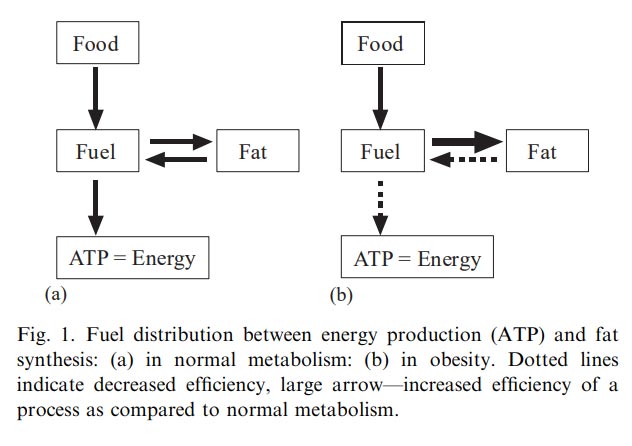
On the right is the "obese" metabolism. The primary differences here are the dotted arrows. The food consumed is turned into fuel, but very little of that fuel is converted into energy. Most of it is instead shuttled into fat storage, and because the metabolism is so inefficient, the stored fat is not released and burned for energy.
Many normal weight people have deranged metabolism too
Not only do obese individuals have this deranged metabolism, but many normal weight people do too. People who exercise a lot, or fast, or eat a low-carb diet may appear to have healthy metabolism because they’re not overweight, but the real reason they’re not overweight is because they’re forcing the conversion of fuel to energy through stress.
So, while they may not accumulate body fat, they still struggle with an energy deficiency, which can present as fatigue, brain fog, low mood, hormonal dysfunction and more.
The bioenergetic solution to these problems is to improve the conversion of fuel to energy, which means you have the energy available to properly function in terms of all your organ systems — your digestion, your reproductive systems, cognitive function, all of that.
Endotoxin and PUFAs decimate mitochondrial energy production
One key strategy to optimize your mitochondrial energy production is to remove blocks in the electron transport chain so that electrons can move smoothly forward, without accumulating and backing up.
Endotoxin (lipopolysaccharide) and other bacterial toxins are among the biggest culprits when it comes to things that hinder mitochondrial energy production. These toxins can directly impair electron transport through the complexes of the electron transport chain. They can also impair certain enzymes in the Krebs cycle.
The primary solution for obesity and most other conditions is to raise your metabolic rate, and a key strategy for that is to remove blocks in the electron transport chain. Endotoxin and polyunsaturated fats (PUFAs) are two key culprits that need to be eliminated.
Poor digestion is frequently associated with negative gram bacteria in your gut that produce endotoxin, and this will inhibit your ability to convert food to energy, resulting in increased body fat. So, it’s important to reduce your endotoxin load. Aside from poor digestion, excess endotoxin is also a common culprit in degenerative conditions, metabolic syndrome, diabetes and fatty liver. To reduce your endotoxin load:
Rebalance your gut microbiome by reintroducing beneficial bacteria (probiotics and prebiotics). One of the best and least expensive ways to do this is to eat a serving of fermented vegetables each day.
Temporarily go on a low-fiber diet and avoid fiber supplements as it can feed undesirable bacteria. Avoid all vegetables temporarily and use fruit juice as your source of calories until your gut microbiome improves. Once it improves you can gradually add in whole fruits.
Once your microbiome is balanced and symptoms of poor gut function have resolved, you can slowly reintroduce starches like white rice and, if tolerated, progress to very well-cooked vegetables. Always cut back if you have signs of indigestion like belching, bloating or gas as this suggests you are not digesting those carbs yet.
Another effective blocker of mitochondrial energy production is polyunsaturated fat (PUFA). These are your processed seed oils, canola oil being among the worst of the worst. Seed oils are loaded with linoleic acid, an omega-6 PUFA, which appears to be one of the primary drivers of chronic diseases, in part due to its detrimental impact on your mitochondrial function and energy production.
So, you’ll want to severely limit your consumption of PUFAs. In addition to not cooking with them, this also means abstaining from processed foods, most of which are loaded with these harmful fats.
While there are no magic pills to fix slow metabolism or low energy production, there are some that can help, such as niacinamide and NMN.
How to gauge your metabolic rate
According to the rate-of-living theory, the higher your metabolic rate — which means the quicker the electrons move from food toward oxygen, which is the final acceptor of electrons — the faster you'll age because there'll be higher oxidative stress.
However, deeper analysis reveals the exact opposite. The truth is, the higher your metabolic rate, the slower you age, because a high metabolism creates fewer reactive oxygen species (ROS) that can damage your tissues.
Your metabolism is high when electrons move rapidly and easily through the mitochondrial electron transport chain, which results in optimal energy production. When electrons are impeded from moving forward, they can back up, leak through the mitochondrial electron transport chain and start moving backward, where they combine with oxygen to create excessive ROS.
So, for optimal health, you want high energy production and that means a high metabolic rate. You can gauge your metabolic rate using your pulse, body temperature and calorie counting. These are not exact sciences, but can give you a general idea of where you’re at. Signs of low metabolism include:
A body temperature below 36,5°C upon waking, and/or 37 °C in the afternoon. You can also check your temperature before and after a meal. If your temperature drops after breakfast (compared to what it was in the morning), this could be a sign of less than optical metabolism as well.
A resting pulse below mid-70 to low-80s, depending on your level of fitness. The greater your cardiovascular fitness, the lower your pulse rate will be, independent of your metabolic state, because your stroke volume is higher. The stroke volume is the amount of blood your heart pumps with each beat. When you’re very fit, your heart can push greater amounts of blood per beat.
Assess how many, or how few, calories you can consume without adding to your weight. If you should be burning 3,000 calories a day, but you're maintaining your weight on 2,200 calories a day, then your metabolism is likely low.
Conversely, if you can maintain your weight when you add more calories, your metabolic rate is likely high, and the extra food will oftentimes improve your sleep, relaxation, energy and recovery.
Summary
Many people start January with gym resolutions but quit by February when results are slow.
Persevere, getting fit matters more than quick weight loss.
Health at Every Size (HAES) promotes health through joyful habits (balanced eating, enjoyable movement) without focusing on weight loss.
It improves mental health and behaviors, though obesity still raises disease risks.
The “fat but healthy” idea is largely a myth—even metabolically healthy obese people face higher long-term risks of diabetes and heart disease.
Obesity often stems from poor mitochondrial function, not just overeating, leading to low energy and fat storage. Fix energy production for better health.
Recent posts
- Better fit and fat than lazy and thin? Fit at every size, yet 'fat but healthy’ is a myth!
- Gut health and sleep: can your microbiome keep you up at night?
- Is chewing gum bad for your health? Chewing gum exposes us to microplastics and may ruin dental health
- Radiation from wearable devices, is it a reason for concern?
- Diabetes and heart disease , how they are related and what can you do about it?
- Acute versus chronic pain: what's the difference and how to get rid of it or learn to cope with it?
- How common are spinal or foot abnormalities?
- Why are fertility rates declining around the world?
- What virus have I been affected by? What is the best way to deal with a viral infection?
- On anosmia, the loss of your sense of smell and how to regain the sense of smell naturally
Author
Contents
Language for this blog

- Vestiging: Wageningen | Julianastraat 99 | 6707 DC | NL
- Telefoon: +31 (0)6 5107 9358
- Mail contact: orders@pasioonline.com
- Bestellingen worden gereed gemaakt voor verzending maandag t/m vrijdag tussen 9.00 en 16.00. Zaterdag tussen 10.00 en 14.00 uur. Bij verzending maken wij gebruik van PostNL en DPD. Afhalen alleen na afspraak en vooruitbetaald. Probiotica worden niet retour genomen.